
OpenXLR has been released in version 0.9.5.
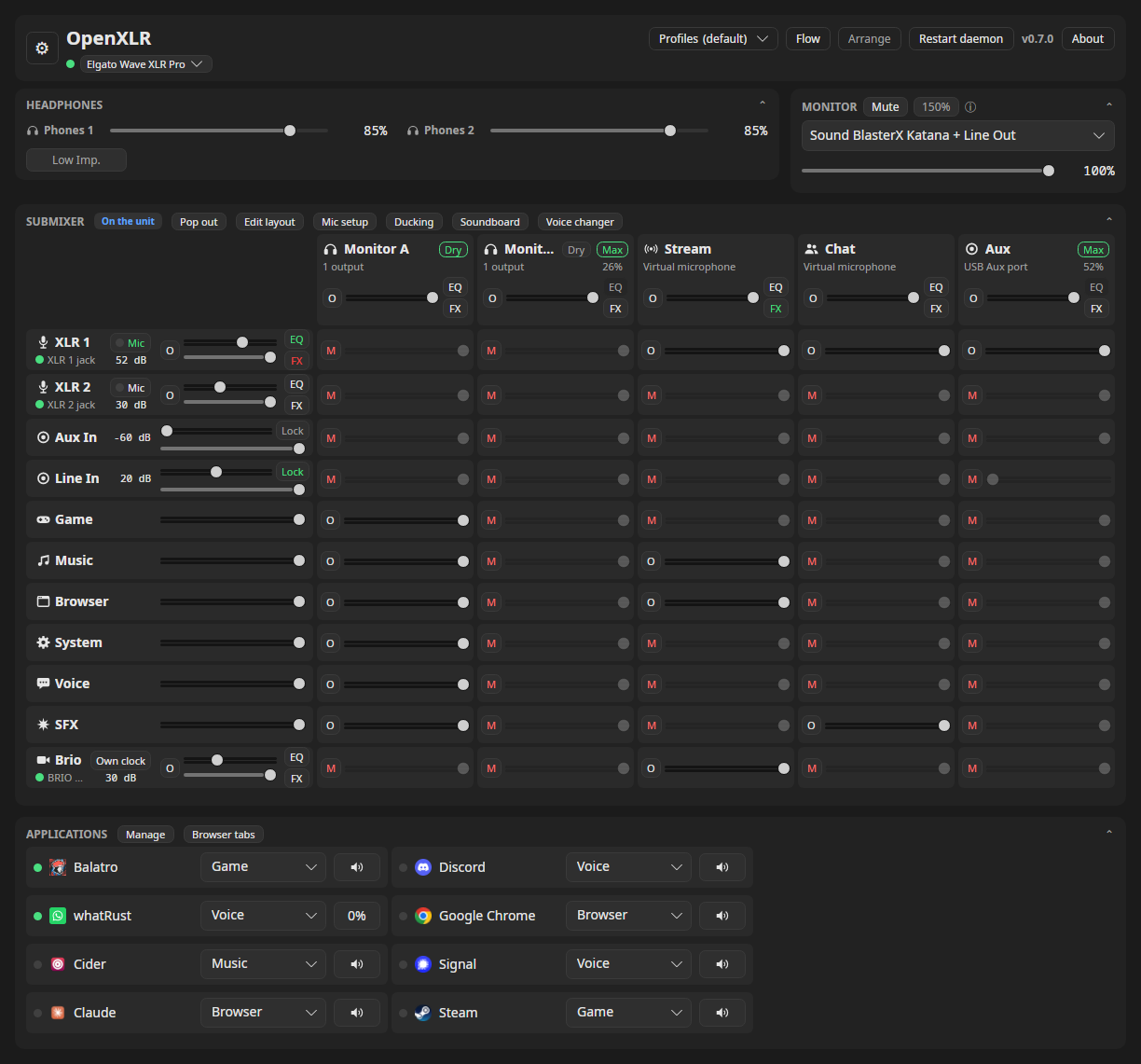
The open-source tool is a Linux replacement for Elgato’s Wave Link, offering a PipeWire-based mixer with effects and an OpenDeck plugin. This update follows version 0.9.4 from November 24.
The biggest change: Windows VST3 and CLAP plugins now run on OpenXLR’s own Windows plugin host. Only Wine is needed, the yabridge companion is no longer required. There is also a French translation, applications can be raised to 150% and routed browser tabs to 125%, plus fixes for the Wave XLR Pro, XLR Dock and Wave XLR MK.2. The daemon must be restarted after updating.
OpenXLR 0.9.5 runs Windows plugins on a Windows plugin host of its own, built into the package. Wine is the only thing to add, and the yabridge companion is no longer needed. This release also adds French, lets applications play up to 150% and routed browser tabs up to 125%, and fixes defects in the plugin host, the daemon, the devices and the Deck plugin.
Windows plugin host
- Windows VST3 and CLAP plugins run on OpenXLR’s own Windows plugin host. The host is part of the
openxlrpackage from the AUR, the PPA and COPR, of the.deband the.rpm, and of the Nix package on x86-64. It starts a small Windows program under Wine, and that program loads the plugin with the code that runs native CLAP and VST3 plugins. A Windows program that dies, stalls or is late plays silence for that cycle and never holds the audio callback, and the daemon rebuilds the chain.- Wine is all the host needs. The packages only suggest Wine, so installing OpenXLR never pulls it in. Install Wine from your distribution and the plugins in the Wine prefix’s
Common Files/VST3andCommon Files/CLAPshow in the plugin picker.- A Windows plugin’s own editor opens on the host. Plugin UI opens it in the same kind of window as every other editor, for VST3 and CLAP, with clicks, the keyboard and the plugin’s menus.
- The plugin’s audio thread gets real-time priority on Ubuntu and Fedora too. Where your user has no real-time limit, OpenXLR asks RTKit, the service that gives PipeWire its priority there.
- The host can be chosen per plugin and for all of them. A bridged plugin’s controls window has a host list: Default host, Always yabridge and Always OpenXLR’s Windows plugin host. Options, Plugins has Windows plugins run on while yabridge is installed.
- yabridge and the companion stay installed and untouched.
mixer.jsonand your profiles are not rewritten, so going back to 0.9.4 works.The editors were tried on KWin only. If you run GNOME, Sway, Niri or plain X11, or Windows plugins on Ubuntu or Fedora, please open an issue and say how the plugins and their editors behave.
Plugins
- The plugin picker lists distinct plugins before copies. Plugins that no earlier entry offers now go in first, across every format, and copies take what is left.
- Insert and profile commands answer during a plugin scan. Those commands now wait only for the short step that removes a plugin file.
- One bad parameter no longer hides every plugin in a CLAP or VST3 module.
Mixer
- Applications play up to 150% and routed browser tabs up to 125%. A quiet application can need more than 100%. A routed browser tab goes up to 125% when the browser companion of this release is installed. From @CarinaSchoppe.
Devices
- A Wave XLR Pro whose USB transfer hangs while its ducking is read is counted as hung and waits the ten seconds before it is reopened.
- The XLR Dock reads its capture gain and headphone level on a kernel that shows either control with two channels.
- A Wave XLR MK.2 in raw capture reports its 20 dB EQ gain range and its compressor and expander levels.
UI
- French. The language picker has Français, covering all 1688 strings, for French locales of every region. No native speaker has read it yet, so corrections are welcome.
Upgrade note
- Restart the daemon after updating, then reopen the UI:
systemctl --user restart openxlr-daemon. A daemon left running from before the update keeps the old code.- Update the browser companion to boost a routed tab. An older companion keeps working at up to 100%.
- The AUR package builds the Windows plugin host and needs
mingw-w64-gccto build, about 1.2 GB that can be removed afterwards.
Source: GitHub