
OpenXLR has been released in version 0.9.4.
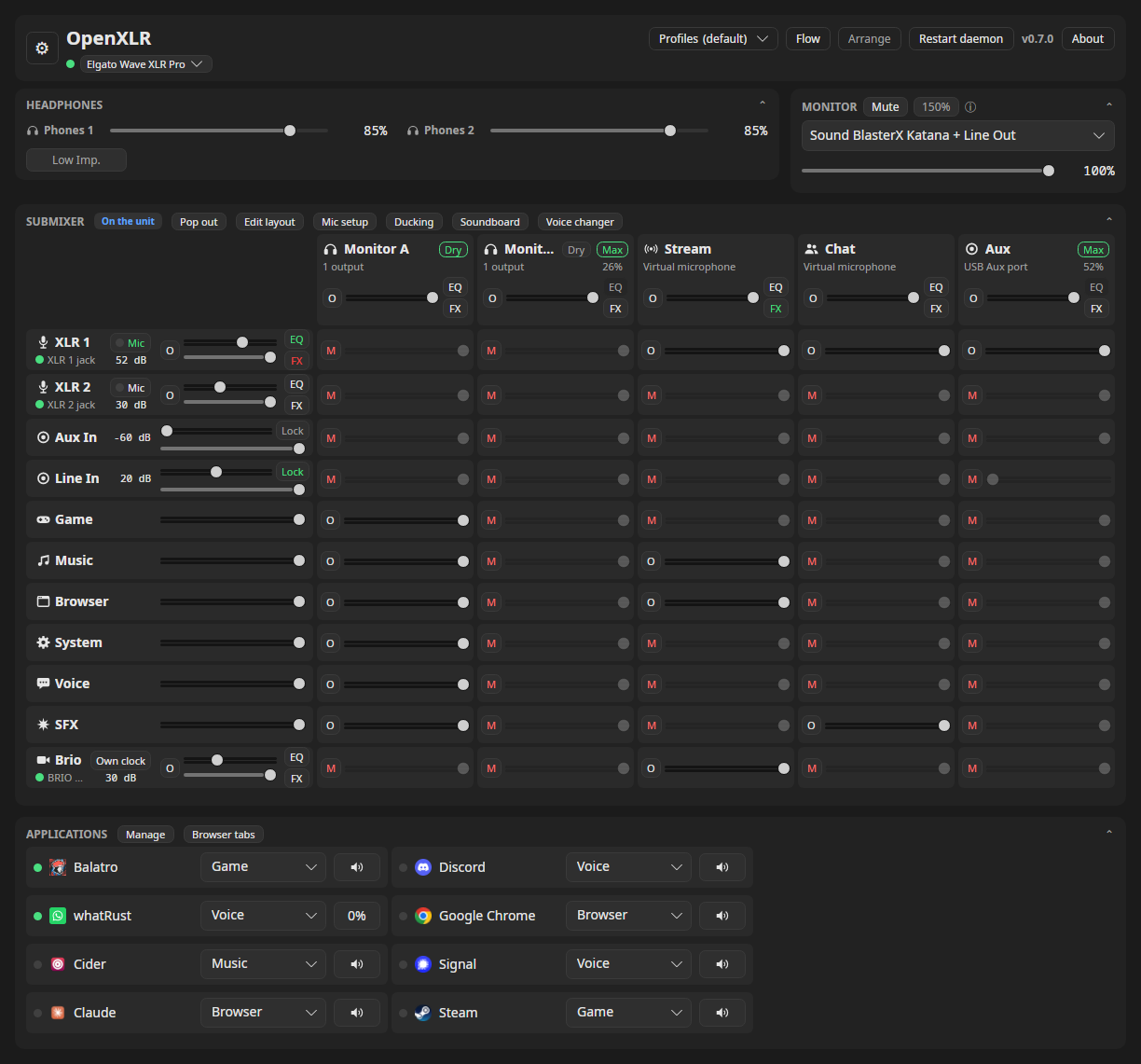
The open-source tool is a Linux replacement for Elgato’s Wave Link, offering a PipeWire-based mixer with effects and an OpenDeck plugin. This update follows version 0.9.3 from November 20.
New is that an application’s volume now counts the stream’s own PipeWire gain. The desktop volume control and pactl do not show it, so a program could play 24 dB down while every level read 100%. That program now reads 40%. The fix comes from CarinaSchoppe.
OpenXLR 0.9.4 makes an application’s playback volume count a gain that the desktop’s volume control does not show.
Mixer
- An application’s volume counts the stream’s own gain. A PipeWire stream can hold a second gain on top of its channel volumes. The desktop’s volume control and
pactlshow the channel volumes only, so a program could play 24 dB down while its level read 100% everywhere. The level OpenXLR shows for a program now counts that gain, in the UI, the terminal mixer andliveVolume, so that program reads 40%. Changing the program’s volume in OpenXLR sets the gain back to unity. The write that lowers the level goes first, so the program is never louder than its old level or its new one. From @CarinaSchoppe.Install
Packages exist for Arch Linux, CachyOS and Omarchy (AUR), Ubuntu 24.04 and 26.04 (PPA), Fedora 44 or newer (COPR) and NixOS (flake); this release also carries a
.deband an.rpmfor a manual install. Each of those, the deck plugin zip and the browser companion has a checksum file and a build provenance attestation; docs/releases.md shows how to check them.Replug the interface once after installing so the udev rule applies. The Stream Deck plugin is the zip on this release, for OpenDeck’s install-from-file, and the browser companion is the
openxlr-browsertar.gz.
Source: GitHub