
OpenXLR wurde in der Version 0.9.1 veröffentlicht.
Das Open-Source-Tool ist ein Linux-Ersatz für Elgatos Wave Link und bietet einen PipeWire-basierten Mixer mit Effekten sowie ein OpenDeck-Plugin. Das Update folgt direkt auf das Stabilitäts-Release 0.9.0 vom Vortag.
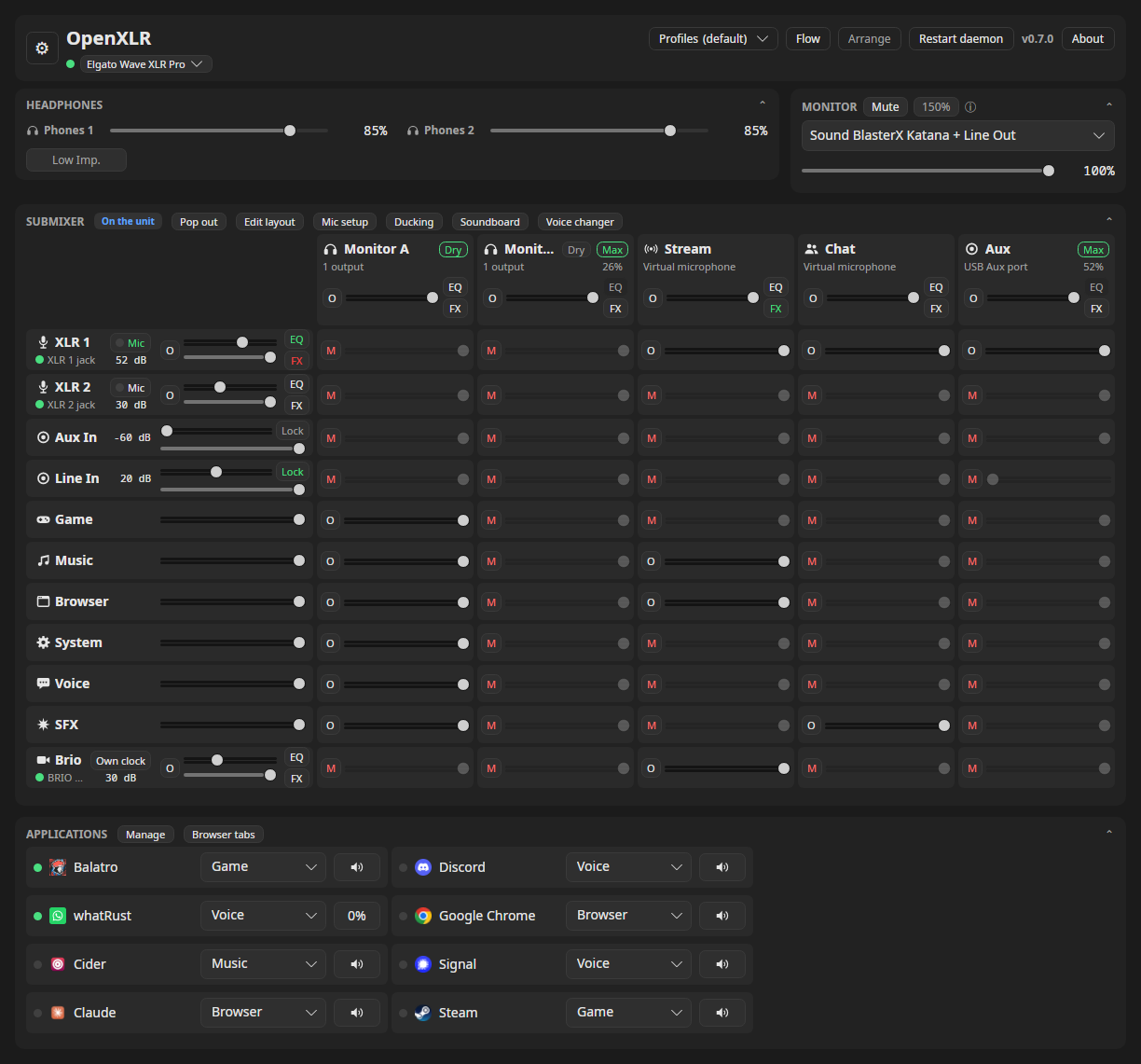
Neu ist ein Line-Out-Pegel für das Wave XLR Pro: Stand der Ausgang am Anschlag nach unten (-60 dB), blieb er stumm, wenn er als Monitor-Ausgang gewählt wurde. Außerdem zeigt die Phantomspeisungs-Lampe nur noch bei aktiver Speisung an, und die Unterstützung für das Wave Neo rückt in der Roadmap nach oben.
OpenXLR 0.9.1 lets you set the Wave XLR Pro’s Line Out level, which nothing on the unit turns, so a Line Out left at the bottom of its range no longer plays silence when you pick it as the monitor output.
Devices
Line Out level on the Wave XLR Pro. The HEADPHONES card has a Line Out fader under Phones 2, on the same 0 to 100% scale as the headphone volumes, with Low Imp. beside it under Phones 1. A unit whose Line Out sat at the floor, -60 dB, played nothing when Line Out was the monitor output, and hardware mixing kept it there. A level set while hardware mixing runs is now the jack’s level from then on, the way a headphone volume turned on the unit is. The terminal mixer has a Line out level row,
lineOutLevelDbis asetcontrol in the API, and undo covers it. A profile does not recall it; the unit keeps the level it was last given.UI
Phantom power lamp. The lamp on a matrix row’s Mic button shows only while phantom power is on or settling, lit red, so the button is narrower the rest of the time.
A layout test lays the HEADPHONES card out in every built-in skin, at both control sizes and three widths, and holds Line Out to Phones 2’s columns and Low Imp. to Phones 1’s.
Project
The Wave Neo moves to the top of the roadmap’s devices: the maintainer has one on the way, so its support no longer waits for an owner’s diagnostics archive.
Pakete gibt es für Arch Linux, CachyOS und Omarchy (AUR), Ubuntu (PPA), Fedora (COPR), NixOS (Flake) sowie als .deb und .rpm. Nach der Installation sollte das Interface einmal neu eingesteckt werden, damit die udev-Regel greift.
Quelle: GitHub