
OpenXLR wurde in der Version 0.9.0 veröffentlicht.
Das Open-Source-Tool ist ein Linux-Ersatz für Elgatos Wave Link und bietet einen PipeWire-basierten Mixer mit Effekten sowie ein OpenDeck-Plugin; Elgato-Geräte wie das Wave XLR oder die XLR Dock werden direkt per USB gesteuert.
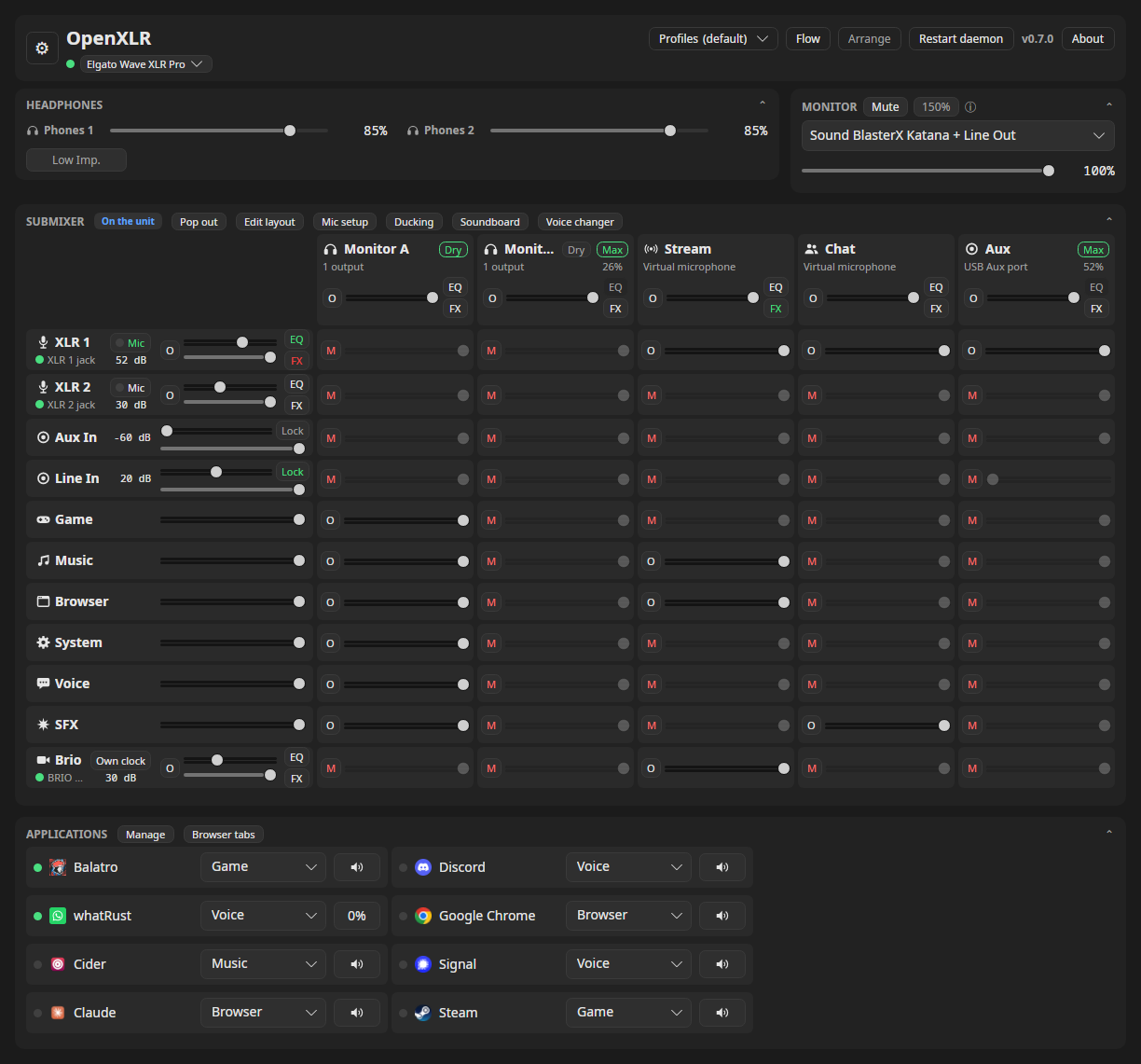
Die neue Version ist das Stabilitäts-Release: Der Daemon übersteht Neustarts von PipeWire-pulse und WirePlumber, fehlgeschlagene Wiederherstellungen und defekte mixer.json-Dateien. Neu sind außerdem verknüpfte Sends pro Kanal sowie einheitliche Bedienelemente in allen Skin-Layouts.
OpenXLR 0.9.0 is the stability release. The daemon now rides out an audio server restart, a WirePlumber restart, a failed restore, a bad
mixer.jsonand a crashing plugin without losing your mixer. The UI, the Deck and the terminal mixer say when something is refused or the daemon is gone. A channel’s sends can be linked to one fader, and every skin arrangement now has the same mix and input controls.Linked sends. A Link chip at the start of each channel’s sends ties them together: the channel plays at one level in every mix, the Aux mix and hidden mixes included, and moving any of its sends moves them all. Mutes stay per mix. A mix added later starts at the linked level,
mixer.jsonand profiles keep the links, and in hardware mixing the unit follows every linked send. The Deck has a key per channel that links or unlinks its sends and lights while they are linked, and the terminal mixer links the selected channel withlon its Mixer tab.Undo and redo. A linked fader move is one undo step for every send it moved, and linking or unlinking is a step that puts the levels back.
Every arrangement has the same controls. The classic mix tiles gained the mix EQ button, the Dry switch on monitor mixes and Max on the mixes the Wave XLR Pro builds, which were only in the banks and the matrix. Broadcast and Wave matrix got a USB chip on the Aux column, a Raw button on Line In and the gain lock on XLR 1. Hi-Fi mix banks start with a Volume key, and the bank masters carry a handle that reorders mixes.
A pipewire-pulse restart no longer restarts the daemon. The daemon notices within two seconds and builds the mixer again in place from the saved layout, with your plugins, ducking and hardware mixing as they were. The service now allows ten starts in five minutes for the restarts that remain.
A WirePlumber restart no longer leaves everything silent. PipeWire runs with systemd’s default of 1024 open files, and with OpenXLR’s mixer built it holds about 700. A WirePlumber restart then ran out of files and linked nothing. The packages now install a drop-in that raises PipeWire’s limit to 65536, and the layout editor warns when PipeWire passes half its limit. The drop-in applies at your next login, or now with
systemctl --user daemon-reload && systemctl --user restart pipewire.The mixer heals more of itself. The sweep that runs every second now brings back a mix or virtual microphone that disappeared, a channel whose sink could not be reloaded, and a meter whose reader died.
mixer.jsonsurvives a crash or a bad edit. The file is flushed to disk before it replaces the old one, carries a version, and leaves the previous copy asmixer.json.bak. One bad value now drops only that entry instead of the whole file, and comments and trailing commas are accepted.A restore that fails partway is retried. The daemon tries again up to three times, and your saved settings stay untouched until the restore succeeds or is given up. USB hangs during a profile recall or a restore are handled like during normal polling. A plugin rescan keeps the old catalogue readable until the new one is ready, and a CLAP or VST3 plugin that asks to restart is restarted in place.
The UI shows when the daemon is gone or says no. While the daemon is down, the input, headphone, monitor and mixer sections are greyed and every meter drops. When the daemon refuses a change, a notice says why and the control goes back. The Deck keeps the keys of missing channels, mixes or profiles, and the terminal mixer says when the daemon is gone.
The documentation was checked against the code from end to end, and the roadmap now leads with stability and hardware acceptance.
Pakete gibt es für Arch Linux (AUR), Ubuntu (PPA), Fedora (COPR), NixOS (Flake) sowie als .deb und .rpm.
Quelle: GitHub