
volt-gui has been released in version 2.3.0.
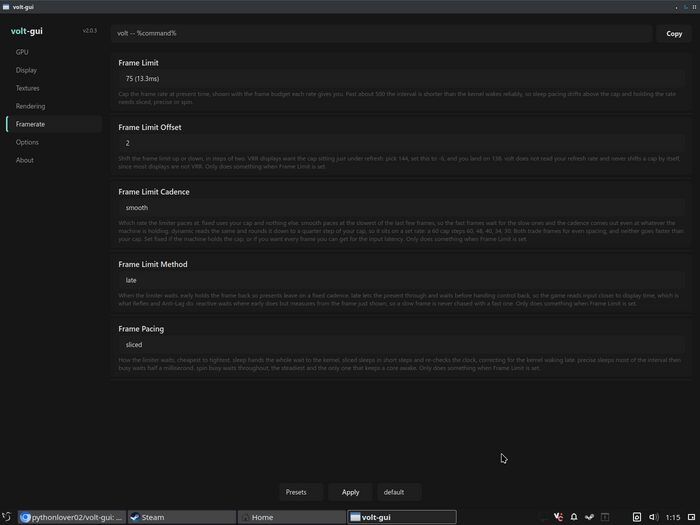
The tool is a Vulkan implicit layer with a graphical interface that lets users adjust Vulkan behavior for games on Linux in a driver-agnostic way, covering things like texture filtering, the frame limiter, and display settings.
After the Flatpak fix in version 2.2.2, this release focuses on the layer internals: volt-gui now follows more of the places where a game can reach the same Vulkan state, instead of watching just one call.
2.3.0 Changes
Mostly layer internals, plus one thing you might notice.
- Texture settings now land on the pipeline and shader paths too. A game using
VK_EXT_descriptor_heapcan bake a sampler into a shader stage instead of callingvkCreateSampler, and that was slipping past.- A present mode list the game chains onto swapchain creation gets narrowed now. Before, a game reaching for swapchain maintenance1 kept a mode you ruled out. Narrow it to nothing and you get the whole list back with a warning.
- Everything above Vulkan 1.0 and
VK_KHR_swapchainis hand rolled against the Vulkan registry now instead of taken from ash.- Replacing a node in a pNext chain rebuilds whatever sits in front of it, the rest goes down by pointer. A node volt doesn’t know leaves the setting alone with a line in the log. The chain the game built is still only read.
- Dropped
vkGetPhysicalDeviceSurfacePresentModes2EXT. Needs full screen exclusive, which is Windows only. Wine answers it inwinevulkanbefore the loader sees it, so DXVK and vkd3d games never bring it down here.Profiles carry over, no setting changed. Off the pipeline paths this is 2.2.2.
Requirements
- Layer: Vulkan 1.0+ with
VK_KHR_swapchain, Linux x86_64 (and i686 for 32-bit games)- Probe:
volt-probe, built and installed alongside the launcher. Every device-backed option list is read through it.
Source: GitHub