
PenguinBurner has been released in version v0.8.0.
PenguinBurner is a tool for managing and optimizing GPUs on Linux, focused on power management, undervolting, and performance tuning. It follows shortly after version v0.7.9.
The headline feature is a new Game Library that brings Steam and Lutris together with background discovery, launcher badges, and sorting, letting you assign a unique power profile per game, including adaptive ones. The release also adds smoother Auto-UV curves, per-tier controls for voltage, clock, memory offset, and power limit, and automatic recovery after failed settings.
Thanks to @Ernold11 for the new Game Library, bringing Steam and Lutris together with background discovery, launcher badges and sorting.
Per each game you can have a unique power profile including the adaptive one!
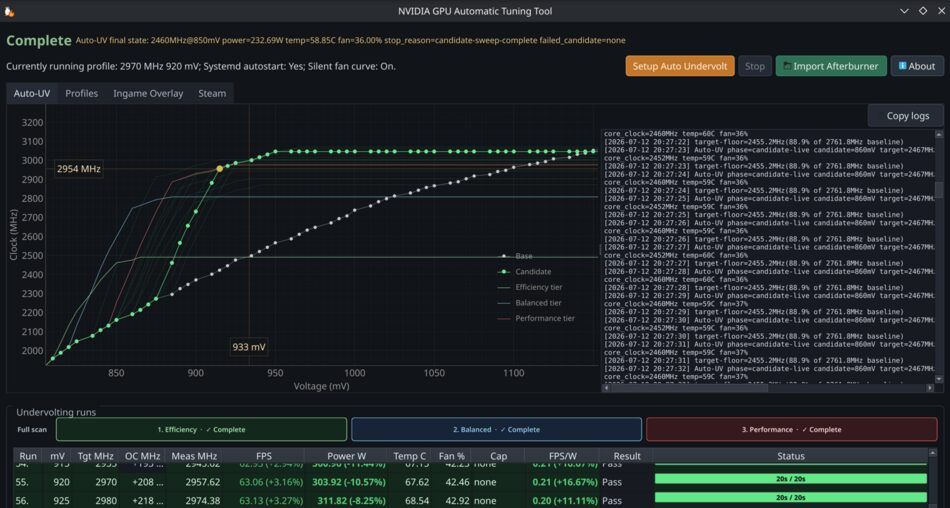
- Smoother Auto-UV curves stay consistent throughout scanning, final verification and profile saving.
- Per-tier controls expose voltage, target clock, memory offset and power limit for Efficiency, Balanced and Performance.
- Lower custom clocks are tested after voltage descent, with bounded searches for GPUs without preset targets.
- Automatic recovery retries eligible safer settings after failed candidates or final checks while respecting crash blacklists.
- Partial results remain available when a later tier fails.
- Adaptive per-game profiles handle FPS caps more consistently and avoid unnecessary tier increases, thanks again to @Ernold11.
Other fixes:
- Clearer profile metrics: absolute FPS/clocks; power percentages against the factory limit.
- Correct live-profile display with the HUD hidden and accurate startup-profile state.
- Stable Auto-UV tab sizing and adaptive timing independent of overlay refresh rate.
- Better Q2RTX installation recovery and Lutris NVAPI-shim handling.
- Preserve game logs and quoted or manually edited launch options.
- Improved distro packaging checks.
Source: GitHub