
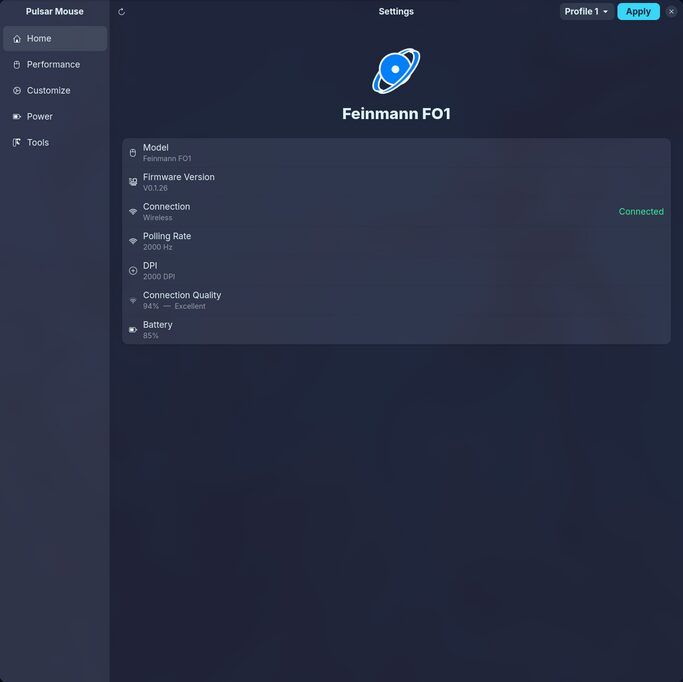
Pulsar Mouse Linux, ein inoffizielles Konfigurationswerkzeug für Pulsar-Gaming-Mäuse unter Linux, wurde in Version v0.1.19 veröffentlicht - kurz darauf folgte Version v0.1.20 mit einer Nachbesserung.
Beide Updates folgen auf Version 0.1.17. v0.1.19 behebt drei Fehler bei ruhenden oder getrennten Mäusen: Apply schreibt keine leeren Seiten mehr auf die Maus, Fenster laden sich bei einer Antwort der Maus automatisch neu, und nach dem Start eingesteckte Mäuse werden erkannt. v0.1.20 erhöht die Zahl der Reload-Versuche einer leeren Seite von einem auf drei.
Änderungen in Version v0.1.19:
This release addresses three bugs discovered in the Pulsar mouse application, all affecting mice in idle or disconnected states.
Apply button protection: “A page that read nothing would write that to the mouse on Apply” - the function now requires successful device communication before allowing changes.
Auto-reload on device response: Windows that fail to read now automatically refresh when the mouse responds, with rate-limiting to one attempt per ten seconds.
Device detection at startup: The application previously ignored mice plugged in after launch. It now checks every two seconds for newly connected devices when starting without one.
All three bugs were identified by @dbergPROTAKT testing on a Pulsar X2 Wireless under KDE/Wayland, verified against an X2A model including simulated arrival scenarios.
Änderungen in Version v0.1.20:
A follow-up to v0.1.19, from the first run of it on hardware.
An empty page gets three goes at reloading itself, not one
The previous version allowed windows displaying nothing to retry only once. Testing revealed the mouse could be responsive yet still fail to populate the page on that single attempt. The timing of configuration register responses proved unpredictable - one contributor’s measurements showed
get_power()timing out immediately after waking an X3.The fix implements three retry attempts spaced 1.5 seconds apart, matching the tray’s existing adoption read pattern, with rate-limiting applied across the entire sequence rather than individually. Additionally, any report from the listener node - not just battery readings - now indicates the mouse is active, rate-limited to once per second since this node serves as the actual input path.
Contributors: f-o-o-g-s, dbergPROTAKT
Quelle: GitHub