
CoolerControl wurde in der Version 5.1.0 veröffentlicht.
CoolerControl ist ein Programm zur Steuerung und Überwachung von Lüftern, Pumpen und AIO-Kühlern unter Linux, mit anpassbaren Lüfterkurven für CPU- und GPU-Kühler.
Das Update bringt Custom Sensors für beliebige Kanalmetriken, detaillierte Chart-Statistiken, Apple-Silicon-Unterstützung und neue Themes. Wichtig: gRPC läuft jetzt auf dem REST-Port 11987 und erfordert Authentifizierung, der separate Port 11988 entfällt.
Added
- Custom sensors for any channel metric: temperature, duty, RPM, frequency and power channels can now be a custom sensor’s source, File sensors are read in their metric’s unit, and a sensor’s driver limits carry through to it (#423, !594)
- A Sum mix function for custom sensors, and a scale on the Offset custom sensor
- Channel units from labels: a trailing unit in brackets, such as
Flow [dL/h], is shown as the channel’s unit in panels, charts, tables, alerts, the Cooling pages and the tray, and a channel with such a unit that cannot be controlled is listed as a sensor (#617, !588)- liquidctl flow channels are labelled
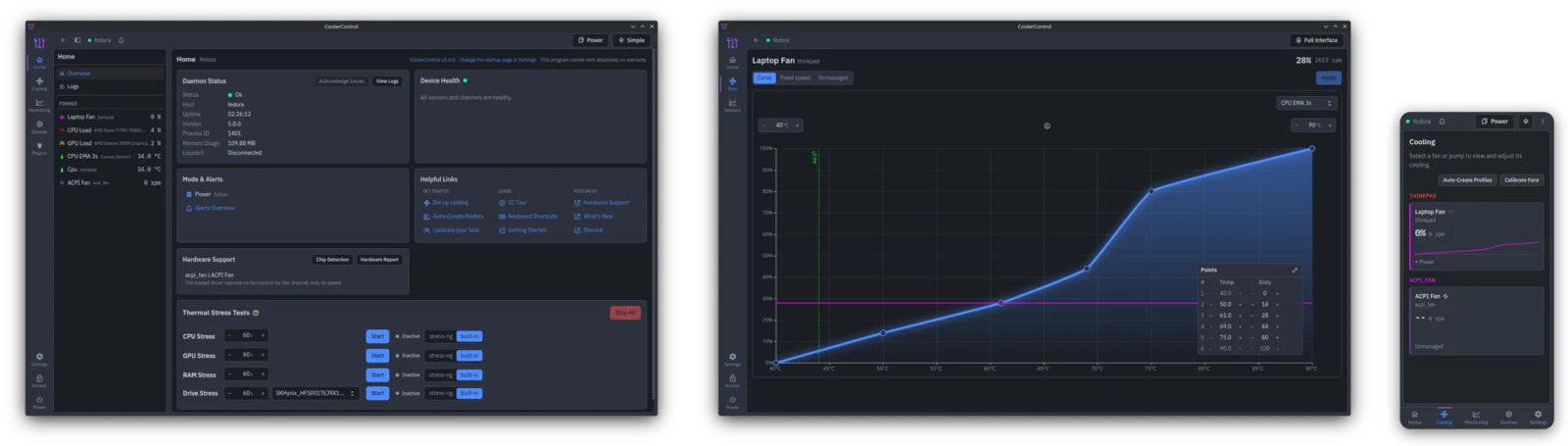
Flow [dL/h]- Individual chart statistics: a stats panel with window and lifetime values, time in range, jitter, and fan direction changes, stops and stalls, plus driver limit lines for temperature maximum, critical, emergency and minimum and for fan minimum and maximum (#613, !586)
- A channel’s driver limits, including rated and power limits, are read fresh each time they are shown, and Leakshield pressure limits are supported
- Dashboard time charts have a stats legend with a since-start switch, a draggable height, and sensors that link to their own charts (!603)
- The alert editor unlocks RPM thresholds above 10,000 up to 9,999,999, groups long numbers, and shows each source’s reference values with the time spent outside the thresholds, in a reworked layout (#612, !587)
- Digit grouping for long numbers in number inputs, dashboards and the side panels, and a higher manual RPM axis maximum
- A debug logging setting, applied at the next daemon restart, with a Debug chip in the header and a copyable
journalctlexport command on the Logs page- Apple Silicon support: a CPU device with the model, load and per-cluster clocks, and fan control through
macsmc_hwmonwhen the module allows it, with fans handed back to the firmware on shutdown (#622, !598, @Daaboulex)- Intel Mac fans stay controllable on Linux 7.3, which changed the
applesmcinterface (#622)- The UI can be embedded in a trusted page, such as Cockpit, through the new
frame_ancestorssetting. The embedding page is told when the UI starts and finishes loading, and can hand its palette to the System theme (#611, !571, !583, !585, !592, @joshuaboud)- Project Felt themes in light, dark and high-contrast variants (!582, @joshuaboud)
- In the browser, the System theme follows light, dark and contrast changes as they happen (@joshuaboud)
- Plugins added while the daemon runs are found without a restart, and starting, restarting or enabling an integration plugin re-reads its manifest, with a reload button on the plugin page
- Plugin UIs can open external links after the user confirms them, through
openLinkin the plugin library (!590)- Remote device-service plugins can be reached over TLS with a
tokenfile, with the remote’s certificate pinned on first use in atls_pinfile, andtls_strictto require a pin placed in advance. The daemon’s own certificate fingerprint is logged at startupCC_SERVICE_DIRsets where plugin service files are written, for distros that mount/etcread only, such as NixOS (!569)trusted_proxieslets login throttling tell apart clients behind a reverse proxy, usingX-Forwarded-For- The Modes page warns when the Mode mapped to the current power profile is not active
- A Monitoring button in the channel page and custom sensor editor headers
- Device icons in selectors are tinted with the device’s color
Changed
- gRPC is served on the REST port, 11987, and needs the same authentication as REST. The separate gRPC port, 11988, is gone, so remote gRPC clients must be pointed at the REST port
- The IPv6 listener is IPv6 only. Setting
ipv6_address = "::"with an emptyipv4_addressno longer serves IPv4 clients through mapped addresses; setipv4_addressfor that- Login throttling is counted per client network instead of globally, with separate budgets for passwords and tokens, and a breaker for remote password failures that clients with a recent successful login bypass
- API connections are capped per client and in total, unauthenticated remote connections share a pool, and slow or idle connections time out.
- The UI’s static files are compressed with gzip at build time, and API responses use gzip only
- Lower and steadier daemon memory use: status history is kept in a fixed ring per device and written in place each tick, health checks read only the daemon’s own process, release builds no longer keep the OpenAPI document, and CPU
/procfiles are read without allocating- The default password check is cached, and needs no password hash when no password is set
- Logs that print a duty say whether it is the true duty or the device duty, and name devices and channels by their labels
- Re-applying a channel’s current setting no longer deactivates the active Mode
- New custom sensors get a hashed id, so a deleted sensor’s id is never reused
- Deleting a custom sensor is refused while an alert, an LCD or a parent custom sensor that would be left without a source reads it, and the refusal names what blocks it. A Mode’s LCD setting that shows the sensor is removed with it
- Renamed channels show their current detected name as a hint, including names migrated from
config-ui.json- The full chart link on a channel page moved below the chart
- The daemon never starts power-profiles-daemon or tuned-ppd itself, and follows their restarts
Fixed
- With
ipv4_address = "0.0.0.0"andipv6_address = "::", only the IPv4 listener came up, and the bind error was hidden. Listener failures are now logged when they happen (#623)- An IPv4-mapped
ipv6_addresscould not be bound- Some API responses were sent uncompressed even with compression enabled
- DDR5 and other i2c sensors lost their settings between boots because their UID followed the i2c bus number. They are now identified by their adapter and address, and existing settings, Modes, calibrations and UI settings are migrated. Downgrading leaves them orphaned (#625, !599, @Daaboulex)
- Corsair Commander ST reads timed out, because its reports were sent at 96 bytes to a 64-byte device (#621, !597)
- Fan readings of 65535 or more, which some drivers report while a fan spins up, were shown as a speed again
- The tas2764 amplifier temperature on Apple Silicon was treated as failed until its first sample (@Daaboulex)
- The power profile Mode was not activated at daemon startup
- The power profile list went stale after power-profiles-daemon restarted, and a blank active profile was taken as a change (!595)
- A plugin that had crash looped could not be started again until systemd’s start limit expired, and a plugin folder added after startup was not made writable for the plugin
- Starting a plugin reported success when it exited at once, enabling it hid a failed start, and the UI did not say why a plugin action failed or refresh plugin status
- A service a plugin manifest no longer lists is removed, and a plugin whose user changed is handed its folder
- A calibrated fan’s kick write that failed left the channel stuck, and a skipped write closed a run of failures early
- NVIDIA GPUs dropped their values when an NVML read went unanswered, and now fail safe once reads keep going unanswered
- Custom sensor history backfill now follows the same missing-source rule as a live tick
- The name of a new custom sensor or alert was saved before it existed, and a new custom sensor did not open after saving
- Pinned rows, Cooling rows and fan cards missed failsafe and not responding warnings, and unreachable channels use a disconnected icon
- Charts kept the previous theme’s colors after a theme switch
- Page charts and tray sensors did not follow a channel rename
- A dashboard with a chart type the version cannot draw now shows a time chart
- Number inputs showed the value before clamping, and RPM axis ticks went missing on large scales
- Plugin health retries are spaced one second apart, so a plugin gets its full start time
apt updateprinted an unsupported architecture notice on hosts with i386 or armhf enabledRemoved
- The separate gRPC port, 11988
- The unused API call for reordering custom sensors
- Brotli response compression
- The global password lockout, replaced by per-client throttling
Security
- The gRPC API now requires authentication
- Plugin UI responses are sandboxed, the plugin manifest link is validated, and the desktop app hands only web links to the browser
- Plugin files are never secured through a link, a hard-linked plugin credential is removed, and a plugin can no longer replace its own manifest
- Vulnerable Rust crates and npm dependencies were updated
Quelle: GitLab